For decades, massage was viewed by the general public primarily as a luxury—a spa treatment reserved for relaxation and pampering. Today, however, the global medical community recognizes it as a critical pillar of clinical rehabilitation and chronic pain management. As patients increasingly seek out non-pharmaceutical interventions for severe ailments, a common question arises in our clinic: What is the actual difference between acupressure massage and traditional massage, and which one is better for my specific condition?
While both modalities utilize the power of human touch to initiate healing, their underlying philosophies, physical techniques, and physiological impacts are fundamentally distinct. At Immerc-Home Global, our experts utilize both. In this comprehensive masterclass, we will break down the neurobiology of both therapies, helping you determine exactly which modality will best accelerate your body's natural recovery.
The Mechanics of Traditional Massage
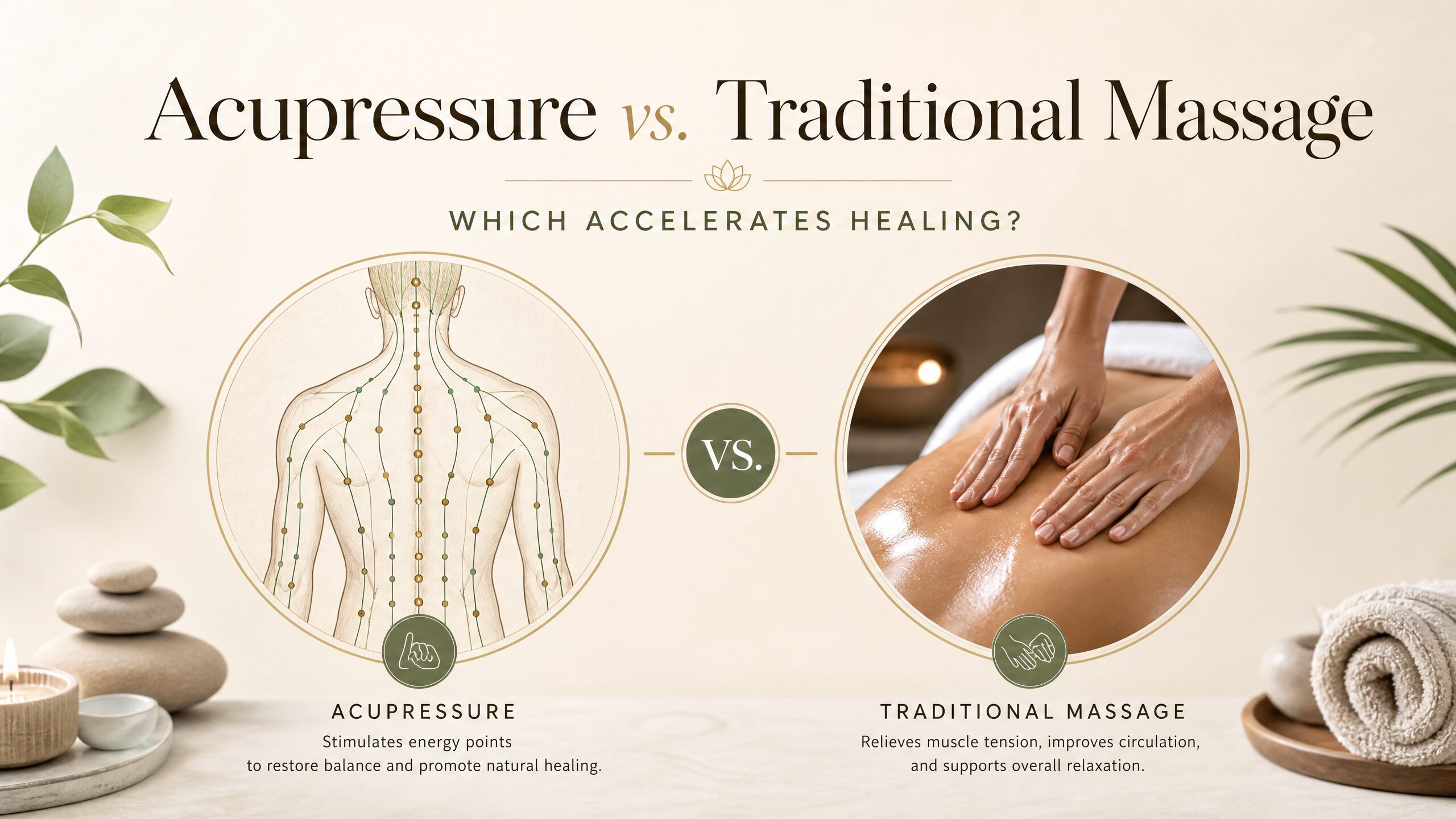
Traditional Western massage therapies—most notably Swedish massage and Deep Tissue massage—focus primarily on the physical anatomy. These techniques target the muscular system, the fascial web (the connective tissue wrapping the muscles), and the lymphatic system.
During a traditional massage therapy session, a practitioner utilizes broad, sweeping strokes, kneading, and localized friction. The clinical goals of this physical manipulation are highly localized:
- Mechanical Vasodilation: The physical friction creates heat, which forces the blood vessels to dilate. This floods tight, ischemic (oxygen-starved) muscles with fresh, oxygen-rich blood.
- Lactic Acid Dispersal: Deep kneading physically pushes trapped metabolic waste products, such as lactic acid, out of the muscle bellies and into the lymphatic system for elimination.
- Fascial Release: By physically stretching the connective tissues, traditional massage breaks down micro-adhesions (muscle knots), restoring elasticity and full range of motion to stiff joints.
The Science of Acupressure Massage
Conversely, acupressure massage operates on a completely different paradigm. Rooted in Traditional Chinese Medicine (TCM), acupressure does not focus broadly on sweeping muscle groups. Instead, it is a highly targeted neurological intervention.
Rather than kneading the muscle, a clinical acupressure practitioner uses their thumbs, knuckles, or elbows to apply static, immense pressure to highly specific points on the body. These points, known as acupoints, lie along the body's energy meridians. Modern neurobiology explains that these acupoints correlate directly with dense clusters of free nerve endings and mast cells.
According to clinical trials reviewed by the National Institutes of Health (NIH), the sustained pressure of acupressure massage bypasses localized muscle tissue and communicates directly with the central nervous system. This triggers a systemic, full-body response:
- Endogenous Opioid Activation: The targeted pressure signals the brain to release a massive wave of endorphins, naturally and immediately muting severe chronic pain signals.
- Organ and Gland Regulation: Because meridians map to internal organs, stimulating specific points (like the Sujok micro-systems on the hands) can actively slow heart palpitations, regulate digestive enzymes, and balance hormonal outputs.
- Autonomic Reset: Acupressure acts as an off-switch for the sympathetic nervous system, physically forcing a patient out of "fight-or-flight" panic and into deep, parasympathetic rest.
"Traditional massage treats the hardware of the body—the muscles and tissues. Acupressure massage treats the software—the nervous system and the energetic electrical grid. Both are vital, but they speak entirely different physiological languages."
Which Therapy Should You Choose?
The choice between acupressure and traditional massage depends entirely on the root cause of your ailment. Here is a clinical breakdown of which therapy is best suited for specific conditions:
1. Severe Stress, Insomnia, and Anxiety
The Winner: Acupressure Massage. Because anxiety is a neurological loop, attempting to rub the muscles is often insufficient. Acupressure directly targets the nervous system, drastically lowering cortisol and triggering the release of melatonin for deep sleep. By targeting points like the Yin Tang (forehead) and Shen Men (wrist), practitioners can halt panic attacks almost immediately.
2. Post-Stroke Rehabilitation and Paralysis
The Winner: Acupressure Massage. During stroke rehabilitation, the brain struggles to communicate with the limbs. Acupressure stimulates the dormant nerve pathways, sending high-frequency electrical signals back to the brain to encourage neuroplasticity and cellular regeneration.
3. Postural Stiffness and Sports Injuries
The Winner: Traditional Deep Tissue Massage. If your pain is purely mechanical—caused by lifting heavy weights, hunching over a computer, or suffering a sports injury—traditional massage is unparalleled. The broad strokes are necessary to physically stretch out tight fascia, break down scar tissue, and manually flush out cellular waste.
4. Internal Ailments (Ulcers, Hypertension, Hormonal Imbalance)
The Winner: Acupressure Massage. Traditional massage cannot fix an ulcer or lower chronic blood pressure. However, acupressure practitioners can target the exact meridian lines connected to the stomach, kidneys, and heart, stimulating internal organ repair without ever needing a scalpel or a pill.
The Ultimate Protocol: Integrative Therapy at Immerc-Home Global
In true holistic healing, there is rarely a need to choose just one modality. The most profound clinical recoveries occur when these therapies are integrated. At Immerc-Home Global in Lagos, our certified practitioners do not offer standard, off-the-menu spa massages.
We provide comprehensive medical massage protocols. A typical session for chronic back pain may begin with sweeping traditional deep tissue strokes to heat the fascia and flush out lactic acid, followed by intense, targeted clinical acupressure along the spinal meridians to permanently deactivate the nerve pain signals.
Whether you require mobile care or intensive, 24/7 recovery in our dedicated Care Home facility, our team will design a hybrid therapy plan tailored explicitly to your diagnosis. Stop managing your symptoms and start healing your body from the inside out. Book your comprehensive diagnostic consultation with our specialists today.